How I became an IEEE Senior Member — and how I can refer you
I’m glad to share that I have been elevated to IEEE Senior Member.
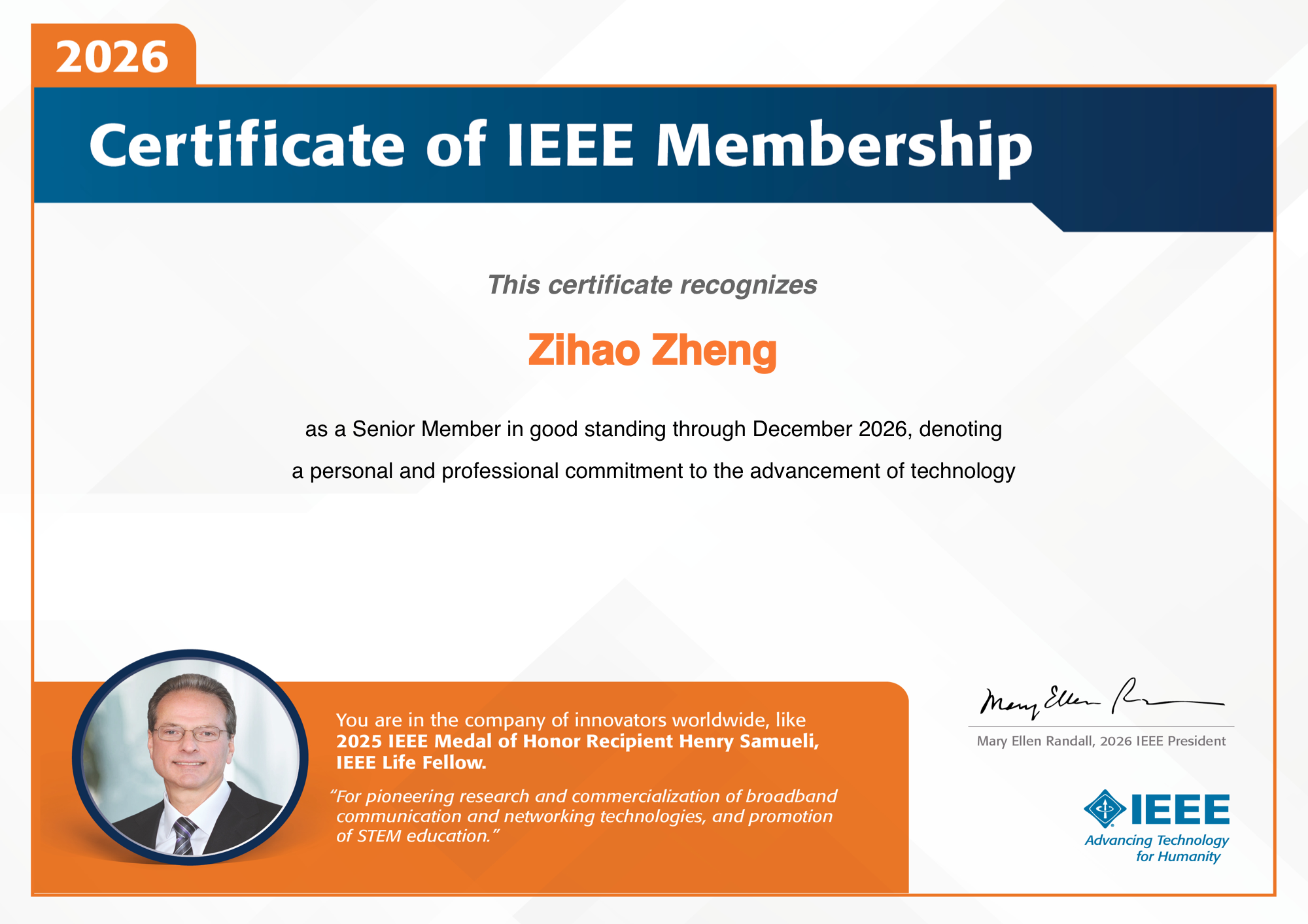
Senior Member is the highest IEEE membership grade you can apply for yourself. It is not a research award and it is not Fellow. It is a recognition of professional maturity: roughly a decade of practice, with several years of significant performance.
This post is a short record of how I went through the process, what I found useful to prepare, and how I can help if you are applying in a related domain.
My timeline
| Date | Milestone |
|---|---|
| 24 Apr 2026 | Created the Senior Member application |
| 24 May 2026 | Submitted the application after all 3 references were completed |
| 25 Jun 2026 | Received the approval / elevation notification |
End to end, that was about two months: one month to gather references and submit, then about one more month until the approval notice.
What IEEE looks for
In plain terms, you need to show that you:
- Work in an IEEE-designated field (engineering, computing, AI/ML systems, and related areas count)
- Have about 10 years of professional practice (certain degrees can count toward part of that)
- Have at least 5 years of significant performance — technical leadership, substantial project ownership, research with measurable impact, patents, open-source adoption, teaching/course development, and similar evidence
- Can provide three references from current IEEE Senior Members, Fellows, or Honorary Members
“Significant performance” is broader than people often assume. You do not need a famous award. What you do need is clear evidence that you owned hard problems and delivered outcomes others can verify.
How I prepared my case
My background sits at the intersection of AI infrastructure, speech recognition, and natural language understanding. When I wrote the application materials, I focused less on job titles and more on evidence of impact:
- Production systems at scale — designing NLU and ASR layers for a voice assistant serving tens of millions of households
- Open-source infrastructure with ecosystem adoption — standalone TensorBoard work used beyond a single framework
- Granted patents where I was first inventor
- Sustained technical leadership over multiple years, not a single project spike
A useful framing for the application is:
What did I own → what changed because of it → who else can verify that?
If your resume only lists responsibilities, rewrite it as outcomes before you apply.
The application steps, in practice
- Confirm you are already an IEEE member. Senior Member is an elevation of an existing membership grade.
- Start the Senior Member application on the IEEE site and fill in education, employment history, and professional contributions carefully.
- Attach a clean CV / resume. Make the five-year “significant performance” window easy for reviewers to see.
- Add at least three Senior Member / Fellow references by IEEE member number. The system emails them a reference form.
- Follow up with your references. This is the step that stalls most applications. Do not assume the email was noticed.
- Wait for a review panel. Once the application, resume, and references are complete, a panel reviews the package. Newly elevated members are usually published after the meeting.
Official starting point: IEEE Senior Member elevation.
What I would tell my past self
- Start collecting evidence early: patents, shipped systems, open-source links, acknowledgments, metrics.
- Ask references who can speak to your technical substance, not only your seniority.
- Add more than three references if you can. Three is the minimum, not the optimum.
- Keep the narrative coherent. Reviewers should understand your lane in one page.
- Treat the process as documentation of work you already did — not as a separate “award campaign.”
Happy to refer
If you work in a related domain and are preparing an IEEE Senior Member application, I am willing to serve as a reference for qualified candidates.
I am most useful as a referee when your background overlaps with areas I know well, including:
- AI / ML infrastructure and tooling
- Speech recognition and spoken-language systems
- Natural language understanding for production assistants
- Large-scale deployment of reliable, inspectable AI systems
How to reach out
Email me at zihaolucky@gmail.com with:
- A short note on your current role and years of professional experience
- Your CV or LinkedIn
- A brief summary of the contributions you plan to highlight in the application
- Your IEEE member number (once you are ready to list references)
- The timeline / deadline for the reference
I cannot guarantee a reference for every request, but I will reply if I can help — and I will be honest if I am not the right referee.
The grade is meant to reflect substance, not paperwork. If you already have the substance, the application is mostly about making that substance easy to review.
— Zihao