Patent · Speech Recognition · Deployed at national scale
Indicator Loss for Context-Aware ASR
A voice assistant has to hear names it was never trained on — your contacts, your devices, the song you played last night. I invented an explicit per-step supervision signal that makes that personalisation both instantly updatable and, for the first time, auditable when it goes wrong. Negative user feedback fell 32.9%.
Speech recognisers learn from enormous amounts of general speech. They have never heard your friend's name, your lamp's name, or an obscure song title — and those are exactly the words people say to a smart speaker. So systems keep a per-user list of important phrases and try to steer recognition toward it.
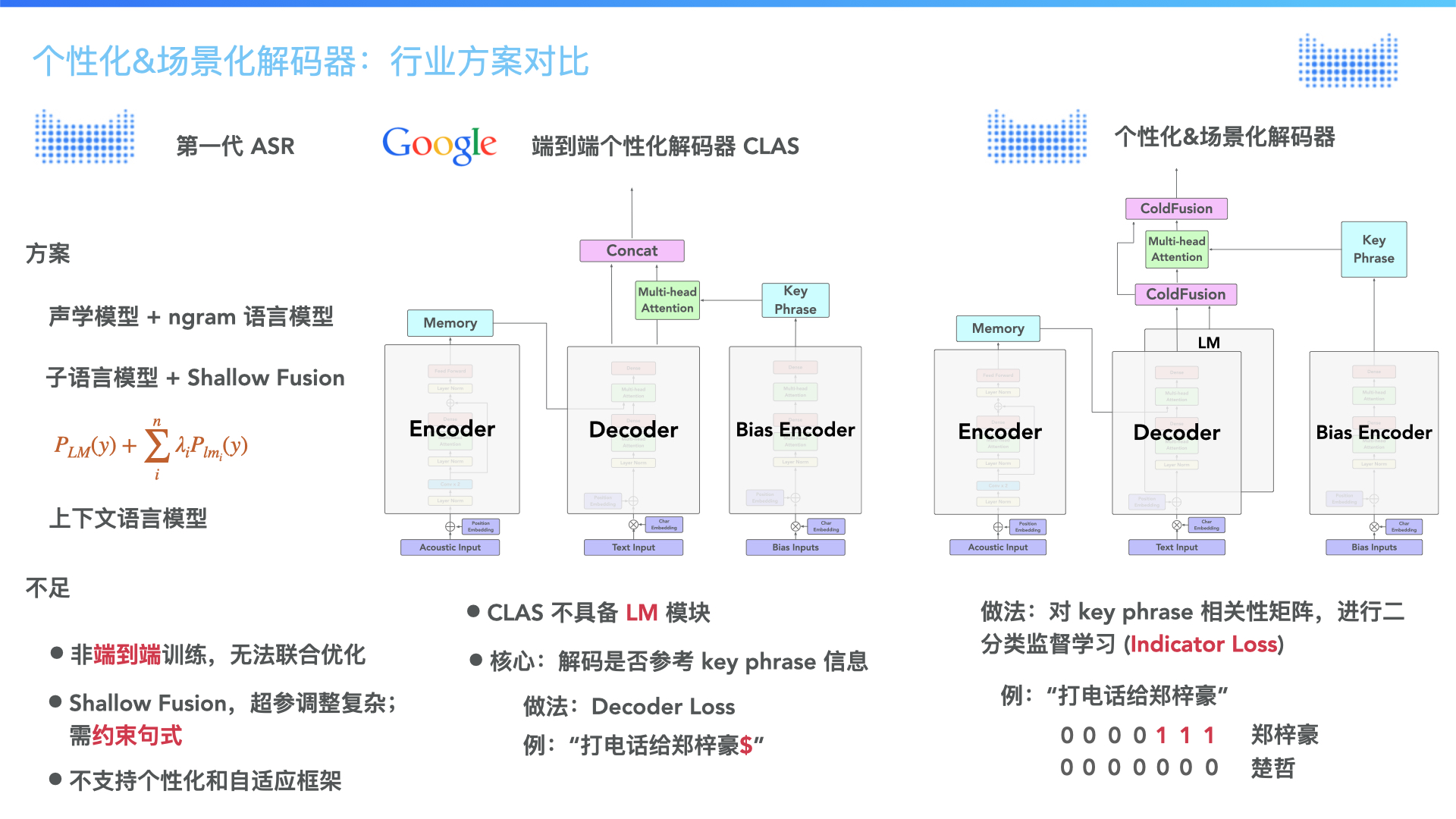
The problem is how you steer. The industry standard, Google's CLAS, leaves that decision implicit: the decoder attends to the list and works it out for itself, so what you can read back afterwards is a soft attention weight rather than a decision. When a phrase is missed, that is not enough to tell you whether the steering was applied and wrong, or never applied at all. And the older generation of systems needed a full language-model rebuild — weeks of work — every time the vocabulary changed.
My design supervises the decision directly: at every step of decoding, for every phrase on the list, the model is trained on an explicit yes/no target saying whether that phrase applies right now. The list can then be swapped at runtime with no retraining, and when something goes wrong an operator can see precisely where the steering did or did not fire.
A failure nobody could see
I was not assigned this problem. I found it by reading daily user-session logs, where the same pattern kept appearing: a request would fail, the user would repeat it, and it would fail again. On 1 January 2020 one user asked for the song 山谷里的思念 — “Longing in the Valley” — six times before the system got it.
These failures were invisible to ordinary monitoring because the system was not producing garbage. It was producing fluent, grammatical, entirely valid text that happened to be the wrong text. Measured across production, recognition accuracy in multi-turn dialogue ran 7.64 to 12.07 percentage points below single-turn, and task completion 2.44 to 8.89 points lower.
The widget below lets you drive the mechanism directly. Turn an entry off and watch a correct transcript decay into a plausible wrong one.
Interactive — edit the list, watch the transcript
Personalisation you can switch on and off, one step at a time
Speech recognition decodes one character at a time. Indicator Loss adds a supervised yes/no target at every step, for every phrase on the user's personal list — contacts, device names, things they have played before. Tick an entry off below and watch the transcript degrade into a valid-looking phrase that means something else entirely. Tick it back on and it recovers. Nothing is retrained in between.
This interactive needs JavaScript. In short: each entry on a user's personalisation list carries a per-step binary target telling the decoder exactly when that phrase is in play. Removing an entry changes the transcript immediately, with no model retraining; and because the targets are explicit, an operator can see whether biasing fired rather than inferring it from the output.
The three scenarios are drawn from documented Tmall Genie failure modes. The syllables are identical in each pair — only the characters differ, which is why the failures are invisible to ordinary monitoring: the system returns fluent, grammatical text that happens to be the wrong text.
What the patent does differently
The invention is called Indicator Loss. Alongside the ordinary training objective — produce the right transcript — the model is trained on a second, explicit target: at each decoding step, for each entry on the personalisation list, a binary label for whether that entry is in play.
That single change produces three properties the prior art did not have together:
Updatable
The bias list is an input, not a trained parameter. Adding a contact or a newly launched device brand takes effect on the next utterance instead of requiring a language-model rebuild measured in weeks.
Auditable
Because biasing is supervised explicitly, whether it fired is a logged value. A failed request can be traced to a cause rather than reproduced by guesswork.
Accurate
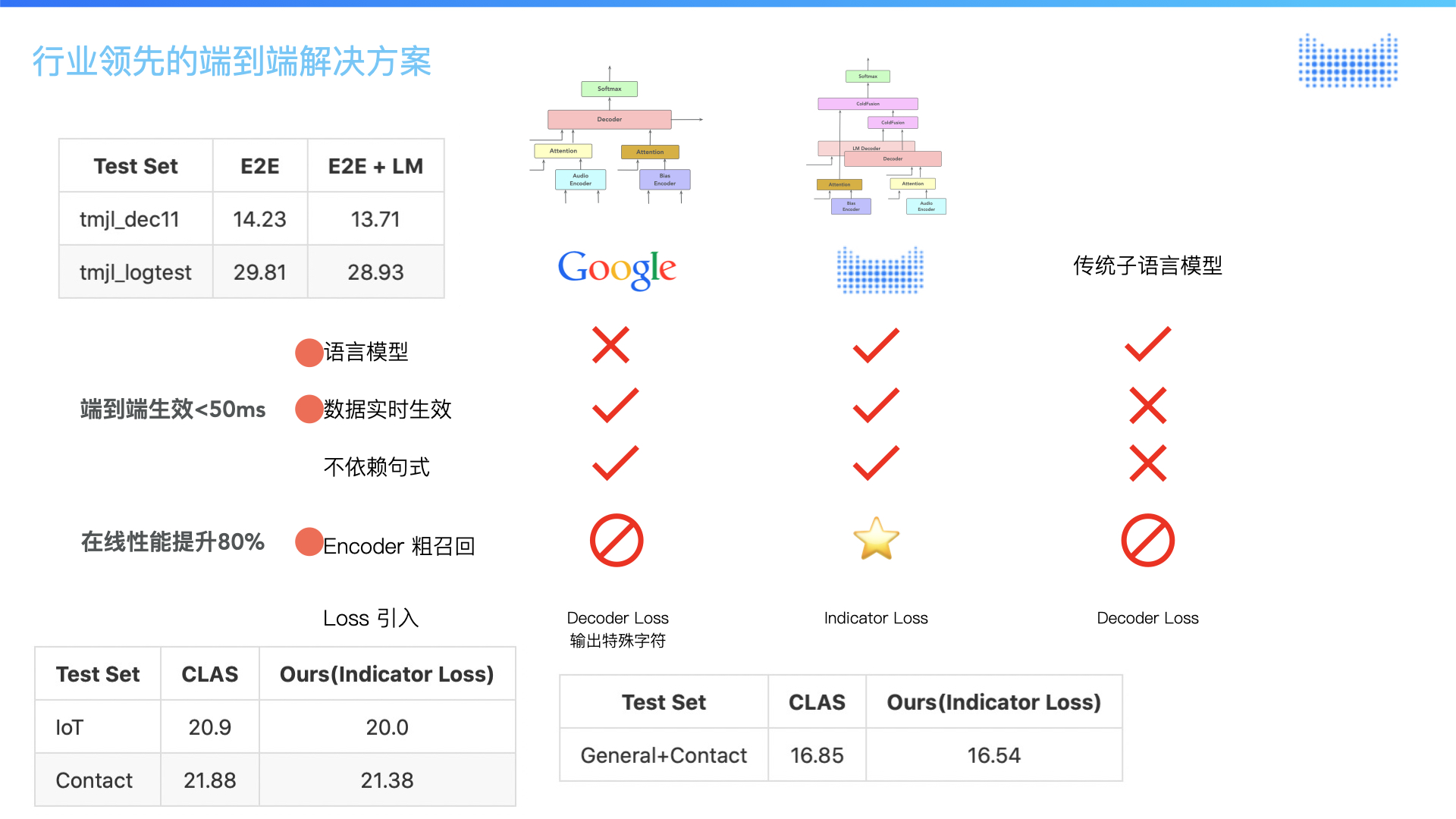
Head to head against Google CLAS, character error rate improved on IoT device names, contact names, and a combined general set — while keeping a language-model module that CLAS does not have.
A complementary mechanism shipped alongside it: a self-correction data loop that mines production logs for fail-then-succeed retry pairs — exactly the six-retry pattern above — and feeds them back as training signal. That loop alone cut negative feedback by 20.16%.
What changed in production
The character-error-rate margins against CLAS are real but modest. The decisive difference is operational: this was the only design in the evaluation that combined real-time vocabulary updates, sub-50-millisecond response, and grammar-free operation — and the only one where an engineer could tell, after the fact, whether personalisation had fired.
Commercial consequence
Recognition failures are not a quality metric on a dashboard — they are the mechanism by which a household stops using a device. Internal analysis across 12.34 million monthly active users found negative-feedback rate inversely correlated with engagement (r = −0.26): users in the low-failure band averaged 16.3 active days per month, users in the high-failure band 11.5. Roughly a fifth of the base sat in that high-failure band.
Removing the retrain cycle also removed a recurring operating cost and a competitive constraint. Under the old architecture, a newly launched smart-device brand or a trending song title could not be recognised until a language-model rebuild shipped. Under this one, the vocabulary is data, changed in seconds.
The architecture long outlasted my tenure. In May 2023 — three years after the deployment period closed, and two years after I left the company — an Alibaba Cloud article describing Tmall Genie’s production speech stack still set it out in the same terms: fusion recognition, and personalised, scenario-aware recognition working along the user dimension and the dialogue-context dimension. Those are the two subsystems this patent covers. A stack still described that way years later, on a platform of this size and through successive model generations, is load-bearing infrastructure rather than an experiment that happened to ship.
Timeline
- 2019Identified the multi-turn recognition gap independently, from daily user-session log analysis.
- Sep 2019 → May 2020Context-aware architecture deployed to production; single-turn/multi-turn accuracy gap narrows from 9.86 points to 1.24.
- 1 Jan 2020The six-retry song request in the logs that motivated the self-correction data loop.
- 16 Jun 2020Patent CN113808593B filed, first inventor.
- May 2023Alibaba Cloud publishes an article describing Tmall Genie's production speech stack in the same terms as this architecture — three years after deployment, two after my departure.
- 2023–2025Explicit step-level supervision for contextual biasing becomes an active line of research at Interspeech, with independent groups in China, the United States, Japan and Singapore publishing across three consecutive cycles. That work was arrived at separately; the point here is simply that the direction taken in production years earlier turned out to be the one the field went on to pursue.
- 3 Jun 2025Patent granted.
The underlying evidence
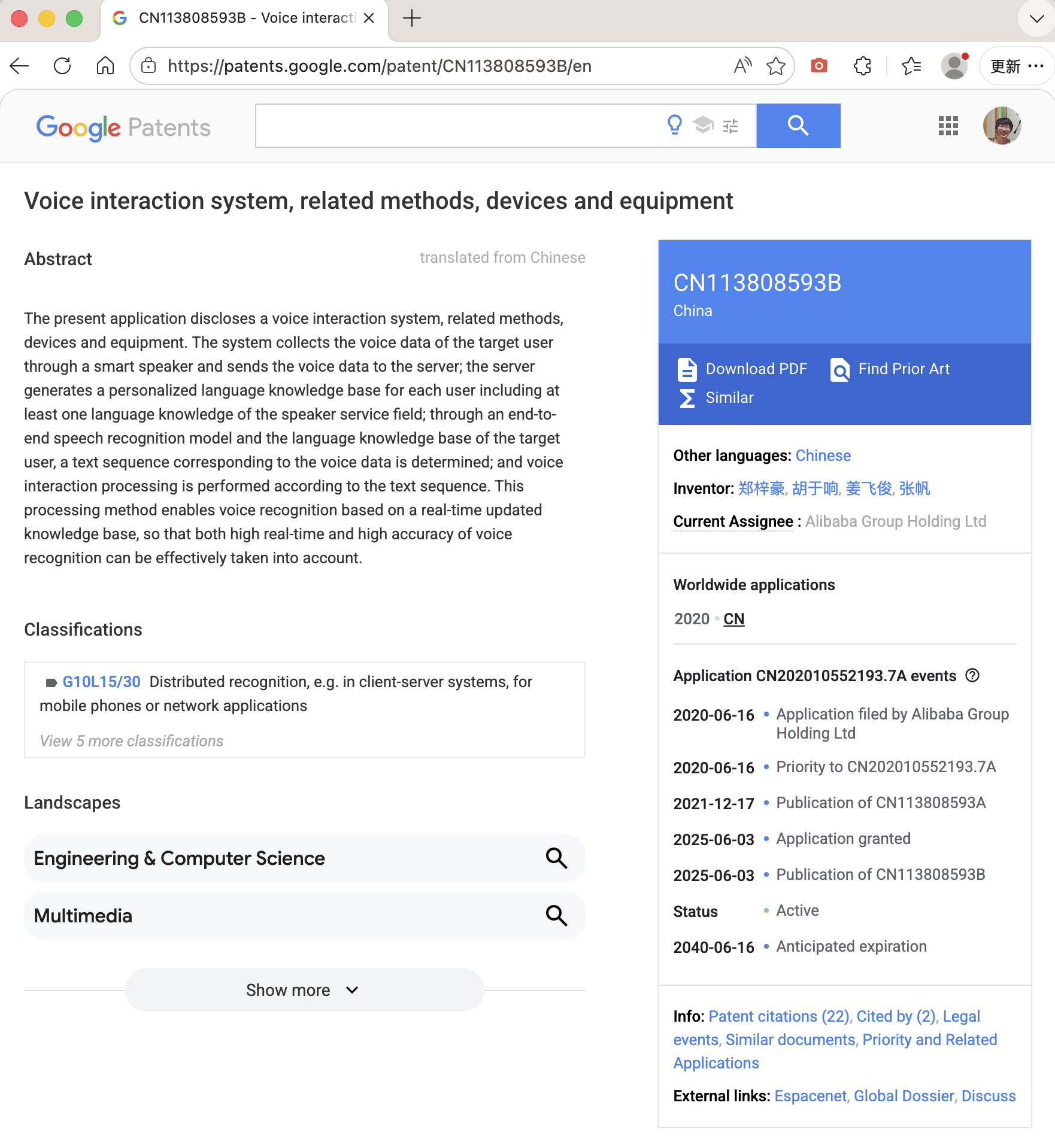
- PatentCN113808593B — Voice Interaction System, Related Methods, Devices and Equipment
- Cited byCN115206299B — Chengdu Qiyingtailun Technology, embedded AI for consumer appliances
- Cited byCN116705004A — Alibaba's successor low-latency streaming ASR team
- Still in useAlibaba Cloud Developer Community, 23 May 2023 — Tmall Genie's production speech stack described as fusion recognition plus personalised, scenario-aware recognition (Chinese)
- FieldDynamic vocabulary-based contextual biasing — how the field frames this problem today
- RelatedMemory-network NLU — the other foundational layer every Tmall Genie command passed through